Eki stamps: Japan's free railway station stamps
Almost every railway station in Japan hides a small free souvenir: its own eki stamp (駅スタンプ) — a rubber ink stamp with a picture of the local castle, mascot, mountain, or festival. You press it yourself, for free, into a notebook, and slowly build a stamped map of everywhere your trains have taken you. There is now a digital version too — JR East's EKITAG app collects the same stamps to your phone with a tap. This guide covers both the paper and digital stamp, where to find them, how the stamp rallies work, and the Japanese you'll use at the gate.

What eki stamps are
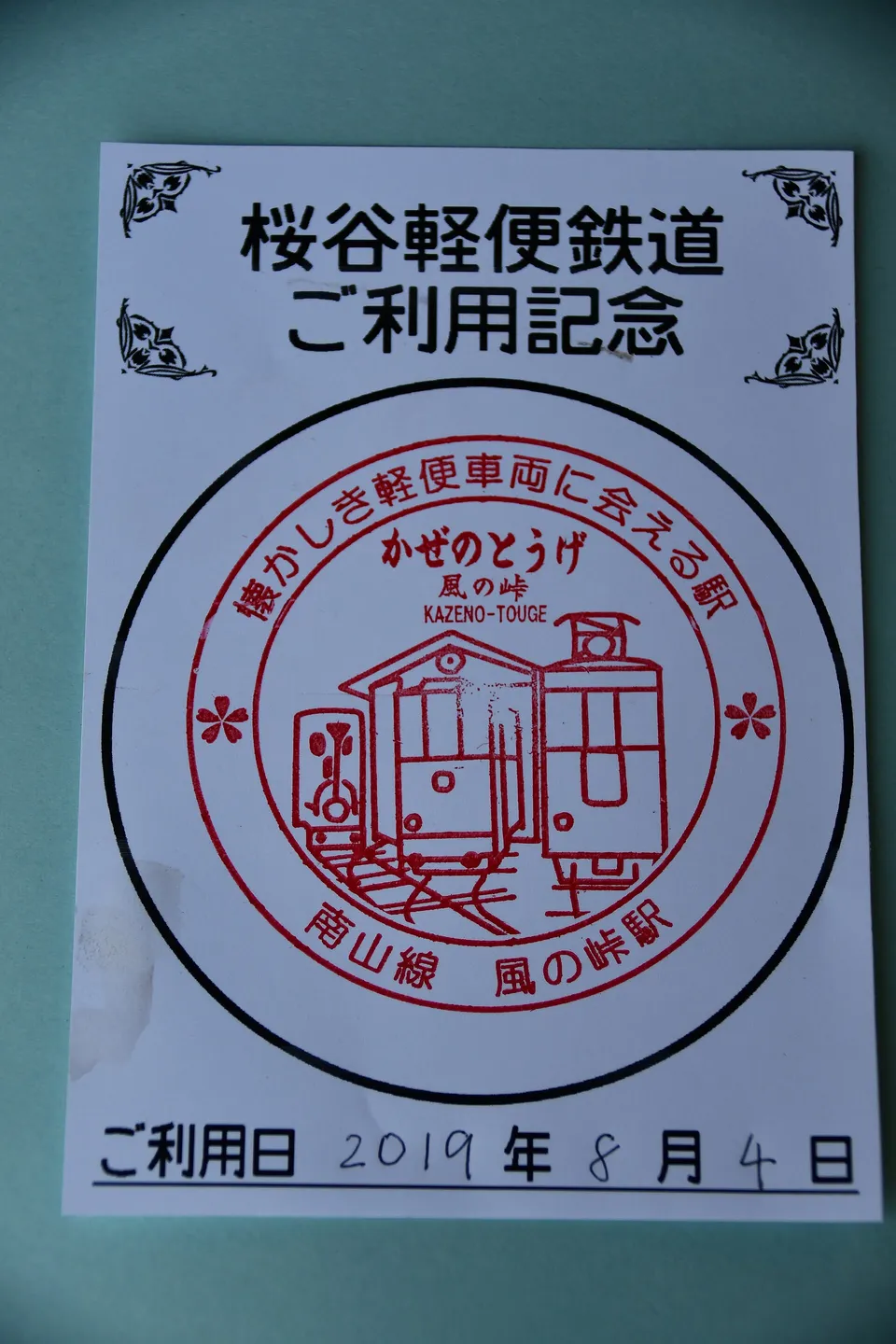
An eki stamp (駅スタンプ, eki sutanpu — "station stamp") is a commemorative rubber stamp kept at a railway station for travellers to press themselves. Each station's stamp carries its own design: the local landmark, the town mascot, a seasonal flower, a famous view. Collecting them is a decades-old travel tradition in Japan — a quiet, free hobby that turns any train trip into a light treasure hunt, one station at a time.
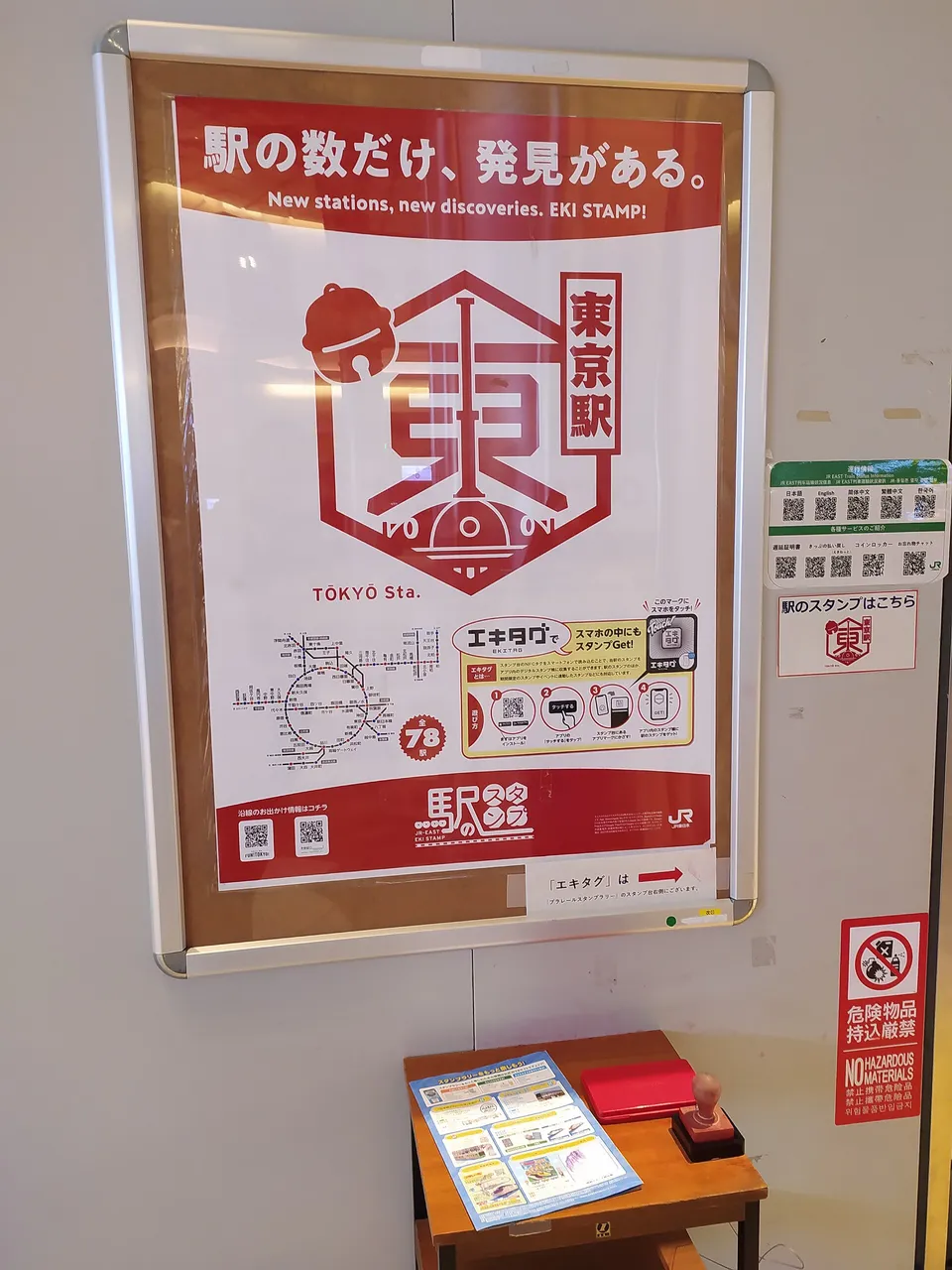
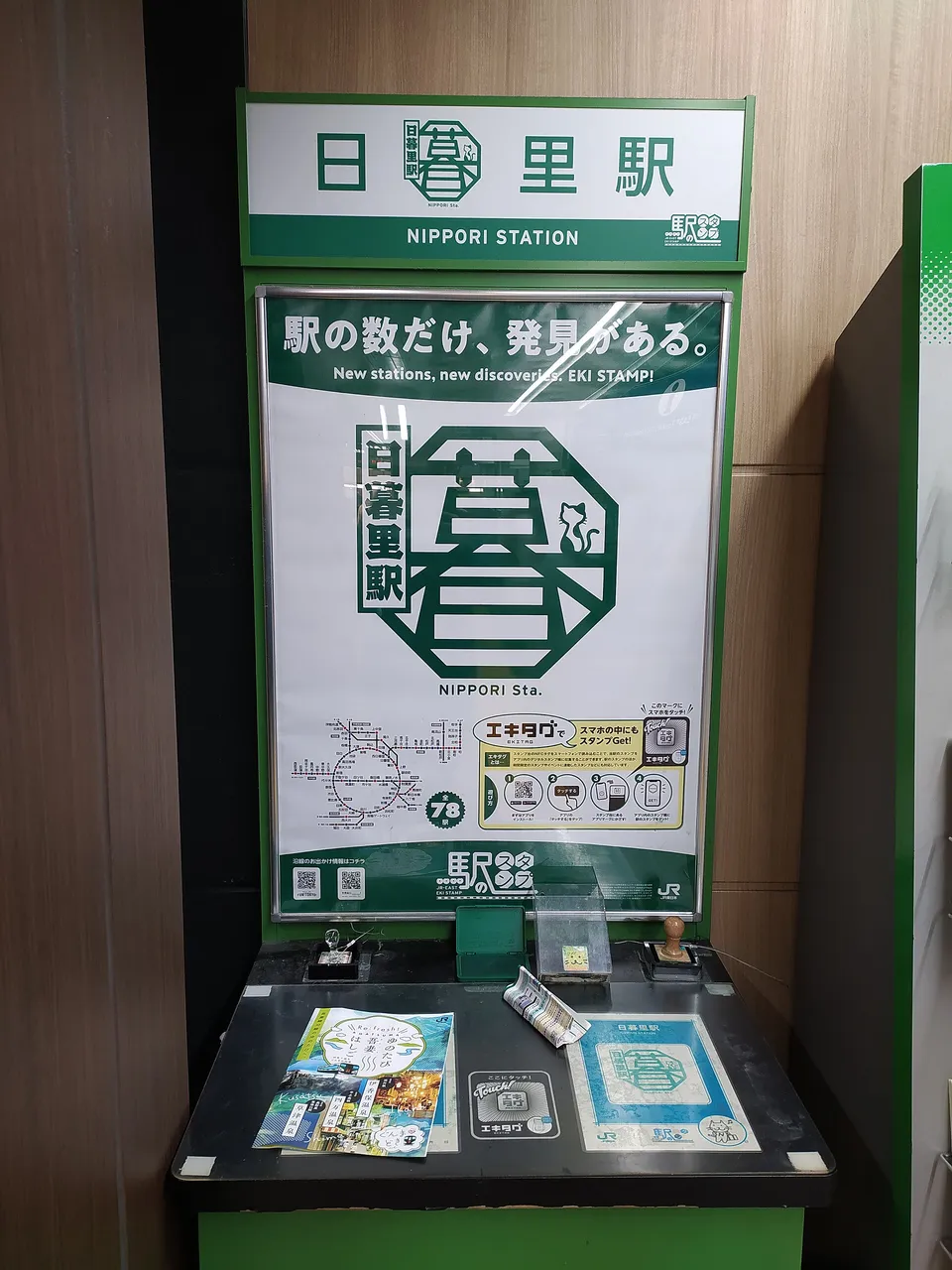
Photos: The Tokyo Station eki stamp, with the Marunouchi building in the design — Artem.G, CC BY 4.0, via Wikimedia Commons · Nippori Station's stamp — Artem.G, CC BY 4.0, via Wikimedia Commons
Two things make them beginner-friendly:
- They're free. There is no charge and no purchase — the stamp and ink pad sit out for anyone to use.
- They're self-service. No staff, no request needed in most cases: you find the stamp, ink it, and press it into your own book.
All you supply is something to stamp into. A blank notebook works; many collectors use a dedicated stamp book (スタンプ帳). Because each design is location-specific, the finished book becomes a personal record of exactly where you travelled.
Stamps press cleanest into a book that lies flat on the stand — the TRAVELER'S notebook (Regular size) is a long-running Japanese favourite for exactly this kind of travel record. We compare stamp books and goshuincho in our stamp notebook guide.
The "Check price" link is an affiliate link (Amazon). We may earn a small commission at no extra cost to you, and it never changes what we recommend. As an Amazon Associate, NihongoHub earns from qualifying purchases.
The free paper stamp
The classic eki stamp is a self-inking or ink-pad rubber stamp, usually sitting on a small stand. Where it lives varies by station, so it pays to know the usual spots.
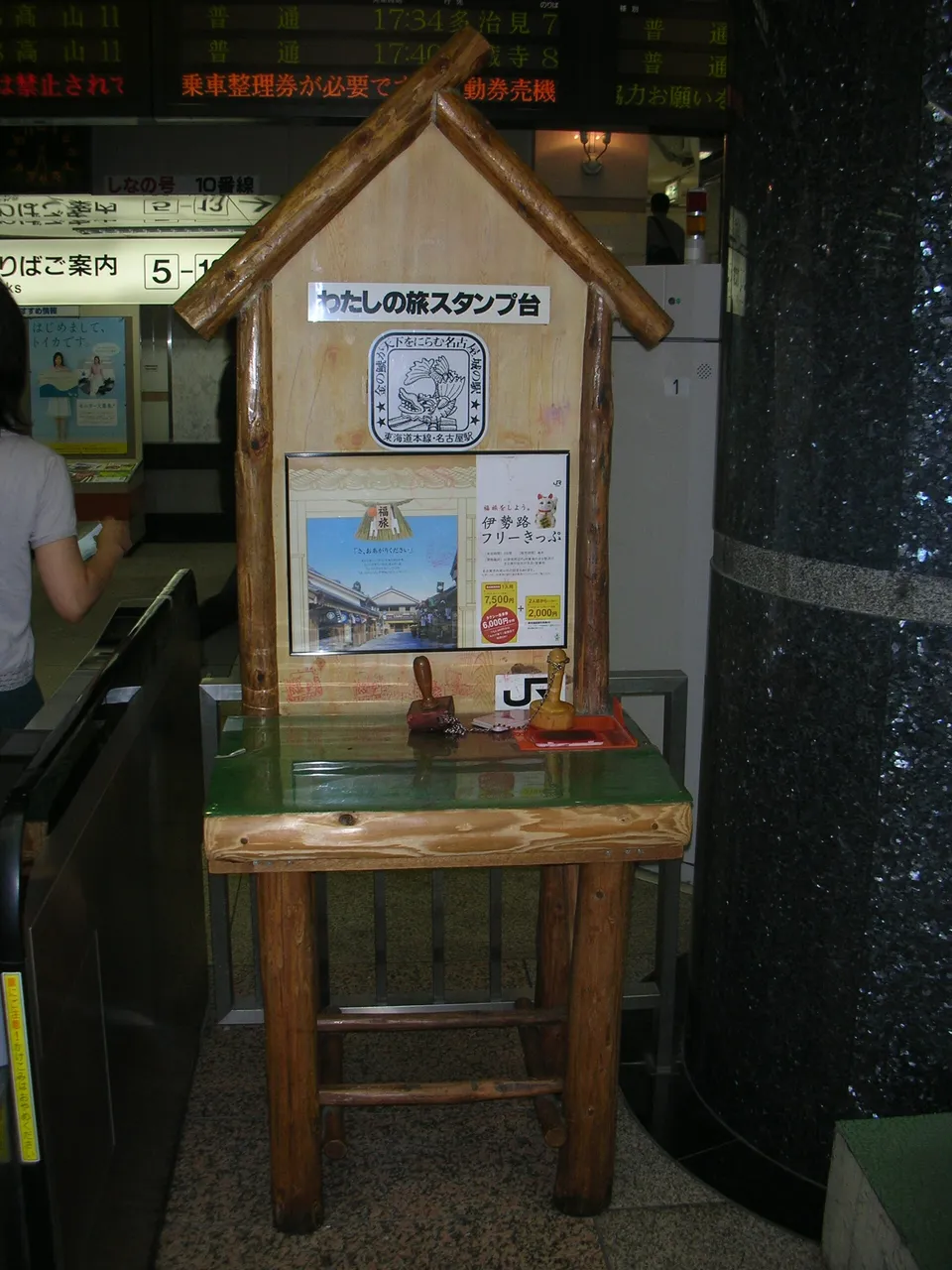
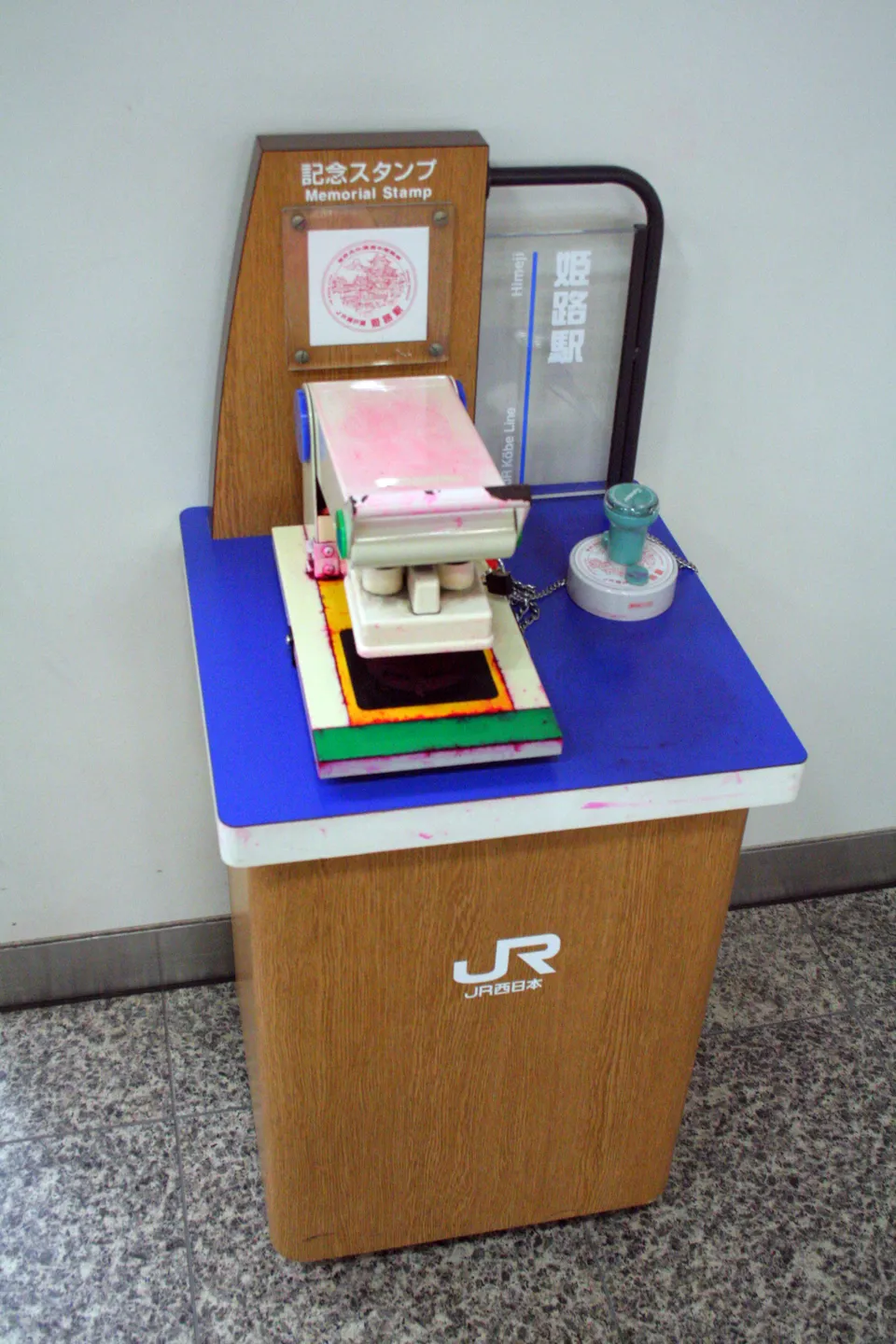
Photos: A "Watashi no Tabi" stamp stand — the classic JR East design — Kone, CC BY-SA 3.0, via Wikimedia Commons · The stamp desk at JR Himeji Station — Corpse Reviver, CC BY-SA 3.0, via Wikimedia Commons
| Where it usually is | What to check |
|---|---|
| Near the ticket gates (改札, kaisatsu) | Often just inside or just outside — if it's inside, you may need a valid ticket or IC card tap to reach it |
| At the station office / staffed window (駅事務室・窓口) | Some stamps are kept at the counter; a quick "スタンプはありますか?" gets it out |
| Tourist information corner (観光案内所) | Bigger stations often group the stamp with pamphlets and maps |
| By the concourse pillars or a dedicated stamp desk | Major hubs (Tokyo, Ueno, etc.) may have a labelled stamp stand |
Ink pads dry out and rubber wears down, so the same stamp can look crisp at one station and faint at the next. Press a test on a scrap of paper first, ink evenly, then press straight down without rocking. Never carry the stamp or ink pad away from its stand — it stays for the next traveller.
A tip for planning: some stamps are inside the ticket gates, so you can only reach them while you hold a valid ticket or have tapped in with an IC card. If a station is just a stamp stop, factor in the minimum fare, or collect it as you pass through on a journey you're already taking.
The digital stamp app (EKITAG)
Since 2023, JR East has run a free digital station-stamp app called EKITAG (エキタグ). Instead of ink, you collect a station's stamp to your phone: open the app at the station, tap the Touch button, and hold your phone to the station's "touch" mark (it uses NFC). The stamp saves to your collection, and you can lay it over a photo you took there.
It is not limited to JR East. As of 1 April 2024, EKITAG covered roughly 56 operators, 141 lines and 832 stations, and that footprint keeps growing wave by wave as more JR lines and private railways join. Treat any figure as a snapshot and check the app for what's currently live.
- Free — download for iOS or Android; search エキタグ (or "EKITAG Digital Stamps") in the store.
- Tap to collect — you must physically be at the station and tap the touchpoint; you can't collect remotely.
- Campaigns — EKITAG regularly runs limited stamp rallies with secret stamps and small mementos for completing a set.
- Both can coexist — a station may have the paper stamp, the digital one, or both. The digital list is smaller than the universe of paper stamps, so many stations are still paper-only.
EKITAG is JR East's own free app — the coverage list grows every wave, so rather than print a station count that goes stale, install it and let it show you which nearby stations have a digital stamp live right now.
How to collect them
The routine is simple and repeats at every station. Paper first, then digital:
| Step | Paper stamp | Digital (EKITAG) |
|---|---|---|
| 1 | Bring a stamp book (スタンプ帳) or notebook | Install EKITAG before you travel |
| 2 | Find the stamp near the gate, office, or info corner | Open the app when you reach the station |
| 3 | Test on scrap paper, ink evenly, press straight down | Tap "Touch", hold your phone to the station's touch mark |
| 4 | Note the date/station beside it if you like | The stamp saves; overlay it on a photo if you want |
| 5 | Leave the stamp and pad where they belong | Check for any active rally you just added to |
Eki stamps fold neatly into ordinary travel — you're already passing through the gate, so a stamp adds a minute, not a detour. Pick a rail line you're riding anyway and treat each stop as a possible stamp.
Stamp rallies & notable stamps
Beyond the permanent station stamps, railways run stamp rallies (スタンプラリー): limited-time campaigns where collecting a set of stamps — often themed around an anniversary, a character tie-in, or a region — earns a small prize or exclusive design. JR East, Tokyo Metro, and many private railways hold them, and EKITAG hosts digital versions with secret stamps.

- Permanent station stamps — the everyday design at each staffed station; always there, free, no deadline.
- Seasonal / anniversary rallies — run for weeks or months; complete the set for a badge, card, or memento.
- Character tie-in rallies — anime, mascots, or game collaborations; popular and often crowded on weekends.
- EKITAG digital rallies — check the app's campaign tab for what's live and where the touchpoints are.
Because rallies come and go, don't build a whole day around one without confirming its dates first — the permanent stamps, by contrast, are always waiting.
Some links above are affiliate links. We may earn a commission at no extra cost to you. We only list services we'd use ourselves.
The Japanese you'll actually use
Most eki stamps are self-service, but a few precise words help when the stamp lives at the counter, or when you need to ask where it is.
| Japanese | Reading | Meaning |
|---|---|---|
| 駅スタンプ | eki sutanpu | station stamp — the collectible itself |
| スタンプ帳 | sutanpu-chō | stamp book — what you press stamps into |
| スタンプはどこですか? | sutanpu wa doko desu ka? | Where is the stamp? |
| 改札 | kaisatsu | ticket gate — a common spot for the stamp |
| 押す | osu | to press / stamp |
| 無料 | muryō | free of charge |
| 記念 | kinen | commemorative — as in "commemorative stamp" |
| スタンプラリー | sutanpu rarī | stamp rally — a limited-time collecting campaign |
Want these to stick? The free JLPT battle quiz drills travel and culture vocabulary like this with spaced repetition.
Station stamps chain naturally with Japan's other location-based collecting games: michi-no-eki roadside-station stamps →, manhole cards →, Pokéfuta manhole covers →, and goshuin shrine & temple stamps →. Many travellers tick off several on one rail line. And while you're on the platform, listen: the same stations have collectible departure melodies → — six on the Yamanote alone, and a different song at all 19 stations of Osaka's loop line →.
Common questions
Q. Are eki stamps free?
A. Yes. Station stamps are free — there's no charge and no purchase. You bring your own notebook or stamp book and press the stamp yourself. The EKITAG digital app is free to download too.
Q. Where is the stamp in a station?
A. Most often near the ticket gates, at the staffed window or station office, or in the tourist-information corner. At major hubs there may be a dedicated stamp desk. If you can't see it, ask staff: "スタンプはどこですか?"
Q. Do I need a ticket to reach the stamp?
A. Sometimes. If the stamp sits inside the ticket gates, you can only reach it with a valid ticket or after tapping in with an IC card. Stamps outside the gates are freely accessible.
Q. What is EKITAG?
A. EKITAG (エキタグ) is JR East's free digital station-stamp app, launched in 2023. You collect a station's stamp by tapping your phone to a touchpoint at the station (NFC). As of April 2024 it covered roughly 56 operators, 141 lines and 832 stations, and it keeps expanding.
Q. Do I need special paper for the stamps?
A. No. Any blank notebook works. Many collectors use a dedicated stamp book (スタンプ帳), and some stations sell themed ones, but plain paper is fine.
Q. What's a stamp rally?
A. A stamp rally (スタンプラリー) is a limited-time campaign where collecting a set of stamps earns a prize or an exclusive design. Railways run them for anniversaries and character tie-ins, and EKITAG hosts digital ones. Always check the campaign dates before planning around it.
We're a Japanese family of three traveling all 47 prefectures with our kid, and this guide comes from that road. Our free newsletter 47 Notes from Japan shares the travel notes, collectible finds, and real-life Japanese that don't fit in a guide. No spam, unsubscribe anytime.