Daruma markets: which eye first, and why you give it back
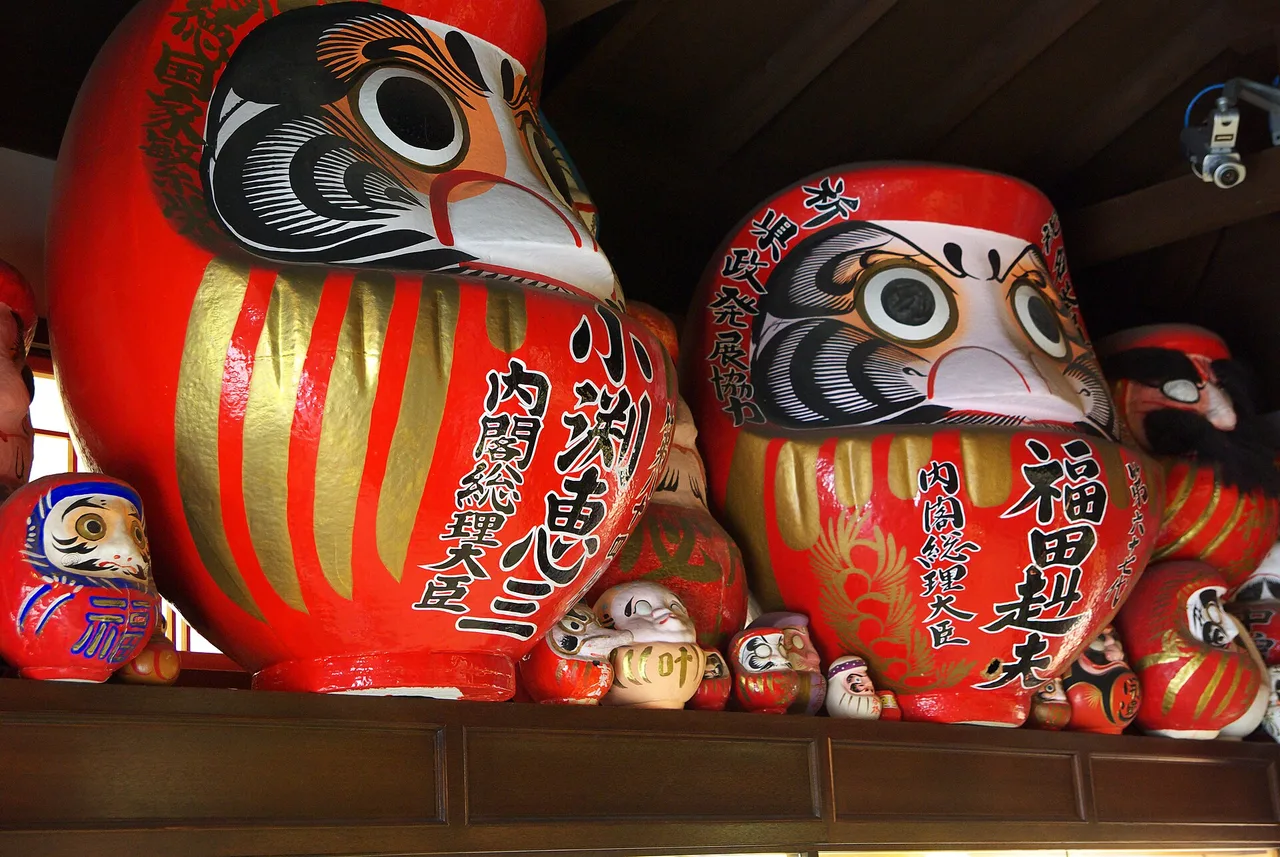
A daruma is a red, round, weighted doll with two blank white eyes. You paint one eye when you make a wish and the other when it comes true — and then, a year later, you are supposed to take it back to the temple to be burned. That last part is the bit foreign guides tend to leave out, and it is the reason the markets exist at all: they are where you return last year's doll and collect this year's. Two markets matter most, and both fall on fixed dates: 6–7 January at Shōrinzan Daruma-ji in Takasaki, and 3–4 March at Jindai-ji in western Tokyo.
The two markets, and their published times
Unlike the November rake markets, whose dates move every year, daruma markets sit on fixed calendar days. Both temples publish their schedules, and both schedules contain hours that surprise visitors.
| Market | Dates | What the temple publishes |
|---|---|---|
| Shōrinzan Daruma-ji少林山達磨寺 — Takasaki, Gunma | 6 and 7 January, every year | Safety prayer at 14:00 on the 6th; the great star-festival prayer at 02:00 on the 7th; the Daihannya sutra reading at 10:00 on the 7th. Daruma stalls stand in front of the main hall. For the most recent market the temple also listed around 30 food trucks behind the hall with seating |
| Jindai-ji深大寺 — Chōfu, Tokyo | 3 and 4 March, every year | The temple's largest event of the year, drawing over 100,000 people. Roughly 300 daruma stalls. Goma fire rituals run all day, roughly every 30 minutes from 9:30 to 13:00 plus a 15:00 service; the monks' procession sets out at 13:45 on each day |
The 02:00 prayer at Shōrinzan is the tell that this is an overnight market rather than a daytime fair: the temple's own calendar places a major service in the small hours between the 6th and the 7th. Outside the market, the temple office and stamp desk run 9:00–17:00, prayer reception 9:00–16:00, and the Daruma Hall 9:00–17:00.
Neither temple had published anything specific to January or March 2027 when this guide was checked, which is normal — these are recurring fixed dates, announced in detail only weeks ahead.
Which eye — the two official answers agree
Search in English and you will find both "left eye first" and "right eye first" stated with equal confidence. Both official Japanese sources say the same thing; they just use different frames of reference, and nobody translates the frame.
Takasaki City puts it from your side: you make your wish and paint in the right eye as you face the doll, and when the year has passed safely or the wish has been granted, you fill in the other one.
Jindai-ji puts it from the doll's side: a new daruma receives the character a (阿) in its left eye — and a doll's left eye is the one on your right.
Facing the daruma, paint the eye on your right when you set the wish. Leave the eye on your left blank until the wish is fulfilled or the year is out. Both official descriptions describe this same eye — one calls it "the right as you face it", the other "the doll's left".
Why you don't keep it
A daruma is not an ornament with an indefinite life. It carries a year's worth of wish, and at the end of that year it goes back to the temple to be burned in a memorial fire — the same treatment given to old amulets and arrows. Shōrinzan describes it as giving thanks to the daruma that watched over you.
Each temple has a published slot for this:
- Shōrinzan holds its daruma otakiage memorial service at 11:00 on 15 January, behind the main hall — eight days after the market, which gives you time to buy the new one first.
- Jindai-ji opens its daruma return desk from 28 February, running through the 3rd and 4th of March, so returns overlap the market itself.
This is why the markets feel like a cycle rather than a shop. People arrive carrying a faded doll with two painted eyes, hand it in, and leave with a slightly larger blank-eyed one.
Returning the doll is the custom, not a rule, and there is no expectation that a visitor flies back to Gunma in January. Buy a small one, paint the eye on your right, and treat the return as optional. Practical note: daruma are papier-mâché, hollow and weighted at the base — light for their size but easy to crush. They travel far better in hand luggage than checked.
Takasaki: the crane, the turtle, and a number nobody can verify
Shōrinzan Daruma-ji calls itself the temple where the lucky daruma began, and Takasaki City states plainly that it is Japan's number-one producer of them. The city also describes what makes a Takasaki face recognisable: the eyebrows are a crane and the whiskers a turtle, two long-life animals drawn into the face, with the wish written in gold on the shoulders — thriving business, safety in the household, a wish fulfilled, a goal reached.
What you will also see everywhere in English is a share figure: "Takasaki makes 80% of Japan's daruma, 1.7 million a year." Treat that with care. Japan's National Diet Library reference service traced the claim and found the published numbers wander badly — 3 million in 1955, 400,000 in 1958, 450,000 in 1966, 1.3 million in the late 1970s and early 1980s, 1.7 million with an 80% share in the 1990s and 2000s, and 900,000 from the 2010s on — with none of the sources citing where their figure came from. When the reference librarians telephoned the Gunma prefectural daruma makers' cooperative, it said it does not keep shipment or sales statistics, and the local chamber of commerce's own article concluded that since neither the national nor the Takasaki figure is known, the share cannot be calculated.
Takasaki is unambiguously the centre of the craft. The precise percentage is folklore with a decimal point.
Jindai-ji: the eyes are Sanskrit
Jindai-ji's market is one of Japan's three great daruma markets, and it does one thing no other market does: the monks write the eyes for you, in Sanskrit characters.
At a temporary eye-painting desk set up in front of the Ganzan Daishi Hall, open 9:00 to 16:30 on both days, a monk brushes the Sanskrit letter a (阿) into the eye of a new daruma — the sound that opens the alphabet, standing for the beginning of things. When you bring the doll back, the other eye receives un (吽), the closing sound, standing for completion. The pair is the same a-un that names the wordless mutual understanding of the guardian statues at a temple gate, one with its mouth open and one closed.
Around this, the temple runs its biggest service of the year. Fire rituals are performed all day at roughly half-hour intervals from 9:30 to 13:00 with a further one at 15:00, applications closing fifteen minutes before each; a service takes about 25 minutes and the hall seats 60. The costumed procession leaves at 13:45 on both days, and moves indoors and out of public view if it rains.
The German architect in the temple garden
One footnote that makes Shōrinzan worth a detour beyond the market. In the temple grounds stands Senshin-tei, a small building put up for the agricultural scientist Satō Kanji — and from 1 August 1934 the home of the German architect Bruno Taut and his wife, who had left Nazi Germany the year before. The stay was meant to last a hundred days; it ran to about two years and three months. A stone in the grounds carries the line he left behind: that he loved the culture of Japan.
The temple's annual calendar still marks a memorial for him each 24 December, alongside the sutra readings and the New Year bell.
November brings the tori-no-ichi rake markets →, the first days of January bring the Seven Lucky Gods stamp routes →, and 6–7 January brings the daruma. If you would rather collect paper than objects, start with goshuin, the shrine and temple seal-stamps →, or the castle gojōin →.
The Japanese you'll actually use
| Japanese | Reading | Meaning |
|---|---|---|
| だるま市 | daruma-ichi | daruma market |
| 縁起だるま | engi-daruma | the lucky daruma — the market kind |
| 目入れ | me-ire | painting in the eye |
| 向かって右 | mukatte migi | "on your right as you face it" — the phrase that resolves the eye question |
| 心願成就 | shingan jōju | a heart's wish fulfilled — often written on the shoulder |
| 目標達成 | mokuhyō tassei | goal achieved — the other common shoulder text |
| お焚き上げ | otakiage | the ceremonial burning of old charms and dolls |
| 納め所 | osamesho | the desk where you hand back last year's daruma |
| 厄除け | yakuyoke | warding off misfortune — what Jindai-ji's festival is for |
| 護摩 | goma | the fire ritual |
| 七草 | nanakusa | the seven herbs of 7 January, which name Shōrinzan's festival |
| 阿吽 | a-un | the beginning and the end — the two Sanskrit eyes at Jindai-ji |
Want these to stick? The free JLPT battle quiz drills travel and culture vocabulary like this with spaced repetition.
Common questions
Q. Which eye of a daruma do you fill in first?
A. The eye on your right as you face it. Takasaki City describes painting the right eye as you face the doll when making the wish; Jindai-ji describes the new doll receiving the Sanskrit letter a in its left eye. Those are the same eye, described from opposite sides.
Q. When are Japan's daruma markets?
A. Shōrinzan Daruma-ji in Takasaki holds its Nanakusa festival market on 6 and 7 January every year. Jindai-ji in Chōfu, Tokyo holds its market on 3 and 4 March. Both dates are fixed rather than moving with the calendar.
Q. What do you do with an old daruma?
A. You return it to a temple to be burned in a memorial service. Shōrinzan holds its daruma burning at 11:00 on 15 January behind the main hall; Jindai-ji opens its return desk from 28 February through the market days.
Q. What is special about the Jindai-ji daruma market?
A. The monks paint the eyes themselves, in Sanskrit. A new doll gets the letter a, meaning the beginning of things, and a returned one gets un, meaning completion. The eye-painting desk in front of the Ganzan Daishi Hall runs 9:00 to 16:30 on both days.
Q. Does Takasaki really make 80% of Japan's daruma?
A. Takasaki City states it is the country's leading producer, but the widely quoted 80% and 1.7 million figures do not hold up. Japan's National Diet Library reference service found the published numbers inconsistent and unsourced, the makers' cooperative said it keeps no statistics, and the local chamber of commerce concluded the share cannot be calculated.
Q. Why is the daruma shaped like that?
A. It is weighted at the base so it rights itself when pushed over, which is the whole point of it as a wish object. Takasaki's version also draws a crane into the eyebrows and a turtle into the whiskers — both long-life symbols — with the wish written in gold across the shoulders.
Q. Can I visit Shōrinzan outside the market?
A. Yes. The temple office and stamp desk are open 9:00–17:00, prayer reception 9:00–16:00 and the Daruma Hall 9:00–17:00. Senshin-tei, where Bruno Taut lived from August 1934 for about two years and three months, stands in the same grounds.