Japanese razors explained: Feather vs Kai, and why both come from Seki
Somewhere in every wet-shaving thread, someone says "just get Feather blades" — and someone else replies that Feathers are too sharp for a beginner, that Kai is smoother, or that you should skip cartridges entirely and buy a Japanese shavette. If you came here from our whetstone guide, you already know the pattern: Japan's edge tools are excellent and the internet's advice about them is contradictory. This guide sorts it out — the three decisions that actually matter, why the town of Seki in Gifu Prefecture sits behind both brand names, and honest notes on five products (three razors, two boxes of blades). It is an editorial comparison built on manufacturer specifications and long-running public user feedback; nothing here is a personal test, and every pick comes with its downside.
How to choose: three things that actually matter
1. Double-edge safety razor vs shavette. A double-edge (DE) safety razor holds a small two-sided blade behind a guard bar; the guard limits how much edge touches you, which is what makes it "safe" and learnable. A shavette is a straight-razor-shaped handle that clamps a disposable blade — no guard, full exposure, and the whole edge is on you. Feather's Artist Club shavettes are aimed at barbers, and the manufacturer's own product copy says so. If you have never shaved with anything but a cartridge, the DE razor is the sane starting point; the shavette is a skill you learn later, if ever.
2. Fixed vs adjustable. Most DE razors have one fixed geometry — the head decides how much blade sticks out (the "gap"), and that decides how aggressive it feels. Feather's Popular is fixed and mild. An adjustable razor lets you change the gap; Feather's version has two settings rather than a continuous dial, so think of it as "mild" and "a bit more" rather than a full range. Adjustability is genuinely useful if you don't yet know what you like — and useless if you already do.
3. How sharp you want the blade — and this is where Feather vs Kai actually lives. Neither company sells one "razor" you compare against the other. Feather makes razors and blades; Kai makes DE blades and barber shavettes, but no DE safety razor handle. So the real Feather-vs-Kai question is about the little blade in the head. Feather Hi-Stainless has a decades-long reputation as the sharpest DE blade on the market; the flip side, repeated across thousands of public reviews, is that it punishes a wrong angle. Kai's blades are consistently described as sharp but a touch smoother and more forgiving. Sharpest is not the same as best-for-you.
Why Seki matters: the town behind both names
Feather Safety Razor Co. is headquartered in Osaka, but the blades themselves are made at its plant in Seki, Gifu Prefecture (関市), where the company was founded in 1932 — the Popular razor's listing carries the "Made in Japan" mark for that reason. Kai (貝印) tells the same geographic story: the group was founded in Seki in 1908 as a pocket-knife maker, is now run from Tokyo, and still concentrates its blade production in Seki. That is not a coincidence. Seki calls itself Japan's "town of blades" (刃物のまち), and the city's own heritage materials trace its swordsmithing lineage to the Kamakura period, roughly eight centuries ago; the Seki Traditional Swordsmith Museum, a Feather-run razor museum and an annual cutlery festival every October all sit in the same small city. If Kyoto's natural whetstones are where a Japanese edge is finished, Seki is one of the places it is born. Our Gifu prefecture guide covers the rest of the region — Shirakawa-go, Takayama, Gero — and profiles the prefecture at 4/5 for culture but only 2/5 for access (NihongoHub 47-prefecture profile data), which matches the travel-time picture below.
| From | To Gifu Station (rail, approx.) | Note |
|---|---|---|
| Tokyo Station | about 120 min | Shinkansen to Nagoya, then local line |
| Kyoto Station | about 60 min | Shinkansen to Nagoya, then local line |
| Shin-Osaka Station | about 70 min | Shinkansen to Nagoya, then local line |
Times from NihongoHub's rail reachability matrix (curated approximations, roughly ±20%, fastest services; the nationwide JR Pass does not cover the fastest Tokaido trains, so add 15–25% on those segments). Seki itself is a further local-bus or Nagaragawa Railway hop north of Gifu city — check a transit app before you go.
At a glance
| Product | What it is | Blade it takes | Skill level | Price band | Best for… | Find it |
|---|---|---|---|---|---|---|
| Feather Popular Double Edge Razorフェザー ポピュラー | Butterfly (twist-to-open) DE safety razor, fixed mild head | Any standard DE blade | Beginner | $ | First safety razor | Check price → |
| Feather Adjustable Double Edge Razorフェザー 調整式 | DE safety razor with two settings | Any standard DE blade | Beginner–intermediate | $ | Finding out how much blade you like | Check price → |
| Feather Artist Club SS Foldingフェザー アーティストクラブ SS | Folding shavette (straight-razor style, replaceable blade); maker recommends professional use | Feather Artist Club blades only | Advanced / barber | $$$ | Barbers and experienced straight-razor users | Check price → |
| Feather Hi-Stainless DE blades, 100フェザー ハイ・ステンレス 替刃 | Platinum-coated stainless DE blades | — (fits any DE razor) | Intermediate+ (very sharp) | $$ | Anyone who wants the sharpest edge and has the angle down | Check price → |
| Kai Stainless DE blades, 100 (20 × 5)貝印 ステンレス 替刃 | Stainless DE blades | — (fits any DE razor) | Beginner+ | $$ | Sharp but more forgiving than Feather | Check price → |
The "Check price" links are affiliate links (Amazon). We may earn a small commission at no extra cost to you, and it never changes what we recommend. As an Amazon Associate, NihongoHub earns from qualifying purchases.
The razors and blades, honestly reviewed
Feather Popular Double Edge Razor — the sensible first safety razor
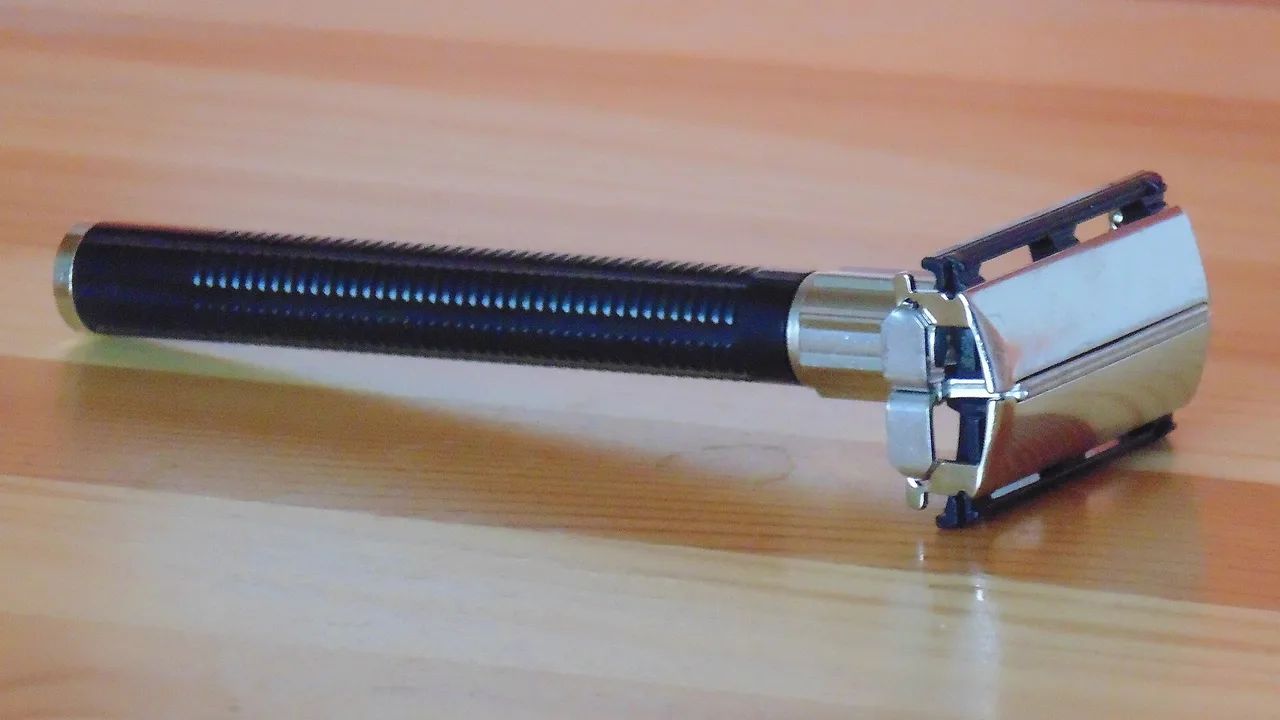
The Popular is Feather's entry-level DE razor and the one most often recommended to people leaving cartridges behind. It is a butterfly (twist-to-open) design — turn the knob at the base and the head's doors swing open so you can drop a blade in without unscrewing anything — with a fixed, deliberately mild head geometry and a light resin-and-metal build. Public ratings sit around 4.5 stars across roughly four thousand reviews, and the recurring themes are consistent: easy to load, mild enough to learn on, made in Japan, and cheap enough that a mistake isn't costly. The same lightness is the honest weak point. Reviewers who move on to heavier all-metal razors describe the Popular as feeling plasticky and a little short in the handle, and the mild head means people who want a more aggressive shave outgrow it. Feather's own answer to that is the AS-D2 (B004E5GV82), an all-stainless razor also made in Seki, in an entirely different price class — worth knowing about, not where most people should start.
✔ Butterfly loading is genuinely simple · mild fixed head suits first-timers · light and inexpensive · Made in Japan
✘ Light resin build feels less substantial than metal razors · short handle for larger hands · mild geometry can feel too tame once your technique improves
Best for: anyone buying their first DE razor who wants the lowest-risk way to find out whether wet shaving suits them. Skip it if: you already know you want a heavy metal razor or a more aggressive head — save up rather than buying twice.
Feather Adjustable Double Edge Razor — two settings, not a dial
Feather's adjustable is best understood as a Popular with a second gear. The head offers two positions — a milder one and a slightly more open one — so you can start tame and step up once you have the angle, all in a razor that still takes any standard DE blade. That is a real convenience for someone who doesn't yet know how much blade exposure they like. Public reception is noticeably more mixed than the Popular's, though: ratings hover around 4.0 stars over a couple of hundred reviews, and the recurring criticisms are the light plastic construction and the fact that "adjustable" here means two steps rather than the continuous range enthusiasts associate with the word. If you are expecting a classic multi-setting adjustable, this will feel limited.
✔ Two settings let a beginner grow into more blade · takes any DE blade · same simple Feather handling
✘ Only two positions — not a true dial adjustable · plastic build, same lightness complaints as the Popular · lower and more mixed public ratings than the rest of the Feather range
Best for: a first razor for someone who suspects the mild Popular might bore them within months. Skip it if: you want a wide adjustment range or a heavy razor — look at metal adjustables from other makers instead.
Feather Artist Club SS Folding — the barber's shavette (read the caveat first)
This is the razor barbers reach for: a stainless-steel folding handle in the shape of a straight razor that clamps a disposable Feather Artist Club blade — a wider, stiffer blade than a DE, sold in several grades (Professional, Professional Super, Light). It gets around 4.7 stars from more than eight hundred reviewers, most of them praising the build quality, the blade change and how it lets a barber deliver a straight-razor service without stropping or honing. Now the caveat, and it matters: the manufacturer's own product description recommends it for professional barbering use. There is no guard. Every millimetre of that very sharp blade is exposed, and reviewers who came from cartridge or even DE razors describe a steep learning curve. It also locks you into Feather's proprietary Artist Club blades, which cost considerably more per blade than DE blades. We include it because it is a genuinely excellent Seki-made tool and because people ask about it — not because it is a sensible home upgrade from a cartridge.
✔ Robust stainless folding build · quick, tool-free blade change · straight-razor experience with disposable blades · very high public ratings among its intended users
✘ Recommended by the maker for professional use — no guard, no forgiveness · proprietary Artist Club blades only, at a higher per-blade cost · steep learning curve for anyone coming from cartridges or DE
Best for: barbers, barbering students, and experienced straight-razor users who want disposable-blade convenience. Skip it if: you are choosing your first non-cartridge razor — that is what the Popular is for.
Feather Hi-Stainless DE blades (100) — the sharpest, and the least forgiving
If one product built Feather's overseas reputation, it is this blade. Hi-Stainless is a platinum-coated stainless double-edge blade made in Seki, and across roughly three thousand public reviews (about 4.8 stars) the same word comes up again and again: sharpest. It is the blade experienced wet shavers keep coming back to, and the 100-count box is the economical way to buy it. The downside is the direct consequence of the upside. A very sharp edge does not tolerate a wrong angle or too much pressure, and public reviews are full of people who tried Feathers in their first week and concluded they should have started with something milder. A second, quieter theme is longevity: some users report the edge feels sharpest for the first few shaves and falls off sooner than they'd like, so "sharpest" does not necessarily mean "longest-lasting". Neither point makes it a bad blade — they make it a blade for someone who already has their technique.
✔ Widely regarded as the sharpest DE blade available · consistent quality, made in Seki · 100-count box is the best value format · fits any DE razor
✘ Unforgiving of poor angle or pressure — a common regret for beginners · some report the edge fading sooner than milder blades · sharpness is not what everyone wants
Best for: wet shavers with a few months of DE experience who want maximum sharpness, and anyone who has tried a sample and knows Feathers agree with them. Skip it if: you are on your first razor — start with a milder blade (Kai below is one option) and come back.
Kai Stainless DE blades (100, 20 × 5) — sharp, smoother, easier to like
Kai is the other Seki name in the head of your razor. The company makes an enormous range of cutlery — kitchen knives, nail clippers, disposable and barber razors — but for the DE crowd it comes down to this stainless double-edge blade, sold as twenty tucks of five. Public reviews (around 4.6 stars, though from a far smaller pool than Feather's — under two hundred) describe it as sharp but smoother and more forgiving than Feather Hi-Stainless, which is exactly what most beginners are looking for. Two honest caveats. First, be clear about what Kai does and does not make: it sells DE blades and barber shavettes, not a DE safety razor of its own, so "a Kai safety razor" isn't a thing — you use these blades in a Feather, or in any other DE handle. Second, the small review count means the consensus is thinner than Feather's; it is a well-regarded blade, but "well-regarded by fewer people".
✔ Sharp yet more forgiving than Feather in public reviews · convenient 20 × 5 tuck packaging · made by a Seki cutlery maker · fits any DE razor
✘ Far fewer public reviews than Feather, so less consensus · Kai makes no DE razor handle to pair it with · enthusiasts chasing maximum sharpness will still prefer Feather
Best for: beginners and anyone who found Feather blades too aggressive but still wants a Japanese blade. Skip it if: you already love Feather Hi-Stainless — there is no reason to change.
Only part of Feather's and Kai's Japanese catalogue reaches amazon.com — some Artist Club blade grades, accessories and Seki-made kitchen cutlery are mostly sold on Japanese marketplaces. A proxy-buying service ships them worldwide — see how to buy from Japan with Buyee vs ZenMarket →. And if you are moving to Japan rather than shopping from abroad, you can buy all of this in any drugstore — the practical arrival timeline is in our moving to Japan guide.
The verdict: one pick per person
- Complete beginner leaving cartridges: Feather Popular, loaded with Kai blades — the mildest combination on this page.
- Beginner who wants room to grow: Feather Adjustable — two steps of blade exposure without a second razor, accepting the plastic build.
- Experienced DE shaver who wants the sharpest edge: Feather Hi-Stainless 100 — the blade Feather's reputation rests on, once your angle is settled.
- Barber or straight-razor user: Feather Artist Club SS Folding — a professional tool, and the maker says so.
- Buying once, for keeps: the all-stainless Feather AS-D2 — the Seki-made premium razor, only if the price class makes sense for you.
The Japanese you'll meet on the box
| Japanese | Reading | Meaning |
|---|---|---|
| 剃刀 / カミソリ | kamisori | razor |
| 替刃 | kaeba | replacement blade — the word on every blade box |
| 両刃 | ryōba | double-edge (DE) |
| 安全剃刀 | anzen kamisori | safety razor |
| 刃物 | hamono | edged tools / cutlery — as in Seki, 刃物のまち, "the town of blades" |
| 関 | Seki | the Gifu city where Feather and Kai blades are made |
| 理容 / 業務用 | riyō / gyōmuyō | barbering / for professional use — the label on Artist Club products |
| ステンレス | sutenresu | stainless steel |
Want words like these to stick? The free JLPT battle quiz drills vocabulary with spaced repetition.
Common questions
Q. Feather or Kai blades — which should a beginner buy?
A. Kai. Both are Seki-made stainless DE blades, but public reviews consistently describe Kai as sharp yet smoother and more forgiving, while Feather Hi-Stainless is the sharpest DE blade on the market and punishes a wrong angle. Learn on Kai (or another mild blade), then try Feathers once your technique is settled.
Q. Does Kai make a safety razor?
A. Not a double-edge safety razor handle, no. Kai sells DE replacement blades and barber-style shavettes; for a DE razor you pair Kai blades with a Feather (Popular, Adjustable, AS-D2) or any other DE handle.
Q. Is the Feather Artist Club shavette suitable for home use?
A. The manufacturer's product description recommends it for professional barbering, and that is our position too. It has no guard and takes Feather's proprietary Artist Club blades. Experienced straight-razor users do use it at home, but it is not a sensible first step away from cartridges — the Feather Popular is.
Q. Where are Feather razors and blades made?
A. Feather Safety Razor Co. is headquartered in Osaka, but its blades are made in Seki, Gifu Prefecture, where the company was founded in 1932. Kai was founded in Seki in 1908 and still concentrates its blade production there. Seki is Japan's historic "town of blades", with a swordsmithing lineage the city dates to the Kamakura period.
How we choose: this is an editorial comparison based on manufacturer specifications and long-running public user feedback — we have not been paid to place any product, and we note what each razor or blade does badly as well as what it does well. Some links are affiliate links — we may earn a commission at no extra cost to you, and it never changes what we recommend or the price you pay.